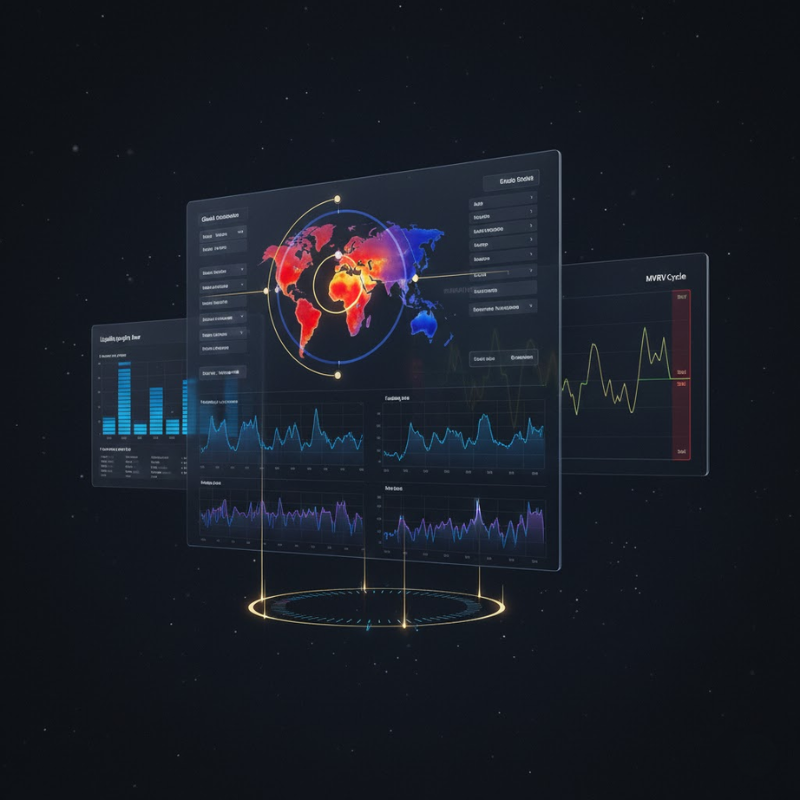
In traditional finance, market timing refers to the strategy of making buying or selling decisions by attempting to predict future price movements. But in crypto market timing, its concept evolves to focus on the structural analysis of market behavior across time. Unlike traditional markets, crypto trades 24/7, aggregates global liquidity, and exhibits distinct volatility patterns. This guide explains how market participants study timing through the lenses of on-chain data flows, macroeconomic events, and recurring market cycles. Crucially, this is an examination of observed behaviors and analytical frameworks.
What Is Crypto Market Timing?
Crypto market timing is the study of when specific market behaviors, liquidity conditions, or price movements have historically been more probable. It is an analytical discipline focused on understanding the structure of time in markets, not a predictive tool. Unlike simple prediction, which seeks to forecast a specific price, timing analysis examines recurring patterns in volatility, liquidity, order flow, and participant behavior across different time horizons.
A common crypto market timing strategy might involve studying how volatility expands during specific global trading session overlaps or how asset correlations shift around major macroeconomic announcements. The objective is to gain context, not to discover a guaranteed best time to buy crypto. This distinction is foundational: analysis seeks to understand probabilities and structure, while prediction often implies certainty.
Bitcoin Halving Cycle and Timing Context
Bitcoin halving cycle provides a fundamental timing context rooted in code. Approximately every four years, the block reward issued to Bitcoin miners is cut in half, reducing the rate of new supply issuance. This halving cycle timing bitcoin is not a short-term trading signal but a long-term structural narrative that analysts observe.
Historically, the 12-18 months following a halving have seen bull markets, while the period preceding it has been characterized by accumulation. However, each cycle has differed in magnitude and drivers. Analysts study these cycles to understand broader market psychology phases, from capitulation to euphoria, but explicitly avoid using them as standalone forecasting tools due to changing market maturity and external macro conditions.
Macro Event Timing: FOMC, CPI, NFP
The growing correlation between crypto and traditional finance has made the study of macro event timing FOMC CPI crypto essential. Volatility regularly clusters around key economic calendars, with Federal Open Market Committee (FOMC) decisions, Consumer Price Index (CPI) prints, and Non-Farm Payrolls (NFP) reports acting as frequent triggers for market-wide repricing.
These events often dictate risk-on vs. risk-off regimes. For instance, a higher-than-expected CPI print can strengthen the US Dollar (DXY), sparking sell-offs in risk assets like crypto. Analysts study the correlation with equities and DXY, noting it typically tightens during macro uncertainty. The hours surrounding announcements are marked by compressed volatility, a calm before the storm, followed by explosive price moves.
What Analysts Observe on Market Timing Indicators
Analysts use a suite of indicators to provide timing context, not definitive entry or exit signals. Common crypto market timing indicators fall into several categories:
- Momentum Oscillators (RSI, MACD): Used to identify periods where an asset may be statistically overbought or oversold within a given timeframe, suggesting a potential pause or pullback is more probable.
- Moving Averages: The interaction between short-term and long-term averages can help define broader bullish or bearish market structure. A cross is not a signal but a lagging confirmation of a trend change that has already occurred.
- Volatility Regimes (ATR): The Average True Range (ATR) indicator helps quantify volatility. Analysts watch for ATR regime shifts to adjust their expectations for price movement ranges.
Funding Rates, Open Interest, and Perp Timing
In derivatives markets, timing analysis focuses on trader positioning. The funding rate in perpetual swap markets is a key sentiment gauge. A persistently high positive funding rate can indicate excessive bullish leverage, potentially preceding a long squeeze. Conversely, deeply negative rates may signal capitulation.
In the other hand, Open Interest (OI) provides context. Rapid OI build alongside rising prices suggests new conviction in a trend. A sharp price move accompanied by OI flush suggests forced liquidations are driving the move, which can accelerate trends or mark their exhaustion. Analysts also watch the basis, for shifts between contango (futures premium) and backwardation (futures discount), which reflect changing market sentiment.
On-Chain Data and Timing Context
On-chain signals provide a transparent view of blockchain activity, offering a different timing lens. Metrics like MVRV (Market Value to Realized Value) and NUPL (Net Unrealized Profit/Loss) help assess whether the market aggregate is in a state of profit or loss historically associated with cycle tops or bottoms. This is timing context, not a precise signal.
Whale wallet activity timing involves tracking large transfers to and from exchanges. An accumulation of assets in cold storage may indicate long-term holding, while a flood of coins to exchanges can precede selling pressure. Similarly, stablecoin flows timing is studied; an increase in the aggregate supply of stablecoins or large inflows to exchanges can be seen as dry powder waiting to enter the market, providing a contextual backdrop for potential buying pressure.
Bitcoin vs Altcoin Timing Differences
Timing dynamics differ markedly between assets. Crypto market timing for bitcoin often revolves around macro liquidity, institutional flows, and its role as a market benchmark. Bitcoin tends to lead market-wide rallies and corrections.
Crypto market timing for altcoins, however, is often relative to Bitcoin. Analysts watch BTC dominance (BTC.D) rotations. Altcoins typically outperform Bitcoin in strong bull market phases when risk appetite is high, and underperform during bear markets or periods of uncertainty. Furthermore, narrative timing plays a huge role. Altcoin sectors like Layer-2s (L2), AI, or Real World Assets (RWA) can see concentrated inflows based on technological or media trends, independent of short-term Bitcoin price action.
Market Timing vs Dollar-Cost Averaging (DCA)
The debate between market timing vs DCA in crypto is philosophical. Market timing (in its active form) attempts to capitalize on market inefficiencies by making concentrated bets at perceived optimal times. Dollar-Cost Averaging (DCA) is a passive discipline of investing fixed amounts at regular intervals, regardless of price, to average the entry cost over time.
Conceptually, successful timing can theoretically outperform DCA, but it requires exceptional skill, discipline, and the ability to manage emotional bias. DCA removes the timing decision entirely, favoring long-term systematic exposure. Most academic and industry research suggests that for the vast majority of participants, consistent DCA outperforms attempts at discretionary market timing, which is often hampered by behavioral errors like fear and greed. This guide does not recommend one over the other but presents the conceptual trade-off: potential outperformance versus behavioral risk mitigation.
Timing Breakouts vs Pullbacks
Market timing approaches often fall into two conceptual camps: momentum and mean reversion. Momentum strategies, like timing breakouts, aim to capture the continuation of a trend once price moves beyond a defined resistance level. The risk is a false breakout or liquidity grab, where price briefly breaches a level to trigger orders before sharply reversing.
Mean reversion strategies, like timing pullbacks, operate on the assumption that price will revert to a moving average or a perceived fair value after an extreme move. The risk here is catching a falling knife during a strong trend where the pullback deepens into a full reversal. Both approaches rely on understanding the broader market structure to contextualize whether a breakout or pullback is occurring within a trend or at its potential endpoint.
Listings, Airdrops, and Event-Driven Timing Windows
Specific crypto-native events create unique timing windows. The behavior of an asset pre-listing and post-listing on a major Centralized Exchange (CEX) is often studied. Prices can pump on listing rumors and sell off on the news immediately after listing, a classic buy the rumor, sell the news pattern.
Airdrop farming timing windows refer to the activity of users attempting to qualify for a token distribution by performing on-chain actions. This can create predictable flows of liquidity and transaction volume on specific networks during the farming period, often followed by selling pressure from airdrop recipients claiming and immediately selling their tokens.
Risk Management and Regime Awareness
Effective timing study is less about pinpointing entries and more about regime awareness. Is the market in a high-volatility, trending regime or a low-volatility, ranging one? Different timing strategies carry vastly different risks in each.
The concept of risk-off timing involves recognizing periods of macro stress or market-wide deleveraging and understanding that during such times, correlations between crypto assets can approach 1.0 (everything moves down together), making diversification less effective. This is when analysts might study hedging contexts, like using perpetual swaps or options, though this is for illustrative purposes only. Ultimately, portfolio timing is a distinct and higher-stakes concept than trade timing.
Limitations and Risks of Market Timing
A rigorous educational guide must emphasize the severe limitations and risks of market timing.
- Data Lag: Most indicators, including on-chain data, are lagging. They confirm what has already happened.
- Overfitting: It is easy to find a pattern that worked perfectly in past data but fails in the future
- Behavioral Bias: Timing decisions are susceptible to emotion. Fear can cause selling at lows, and greed can cause buying at highs.
- Structural Breaks: Crypto is a young, evolving market. Patterns that held in a $100B market cap environment may not hold in a $2T environment. A fundamental shift, like the entry of ETFs, can create a structural break that invalidates old models.
- Costs: Frequent trading based on timing attempts incurs transaction fees, slippage, and tax implications, which can erode any theoretical edge.
How Analysts Study Timing
Professional analysts study timing through disciplined methodologies to mitigate the risks above.
Event Studies
Isolating the price action around a specific, repeated event (e.g., CPI releases) to measure its average historical impact and variability.
Backtesting with Session Filters
Systematically testing a hypothesis across long timeframes, ensuring it is statistically significant and not a random outcome. This process explicitly aims to avoid hindsight bias.
Regime Segmentation
Analyzing whether a timing pattern holds in both bull and bear markets, or during high and low volatility. A pattern that only works in one regime is not robust.
Multi-Factor Context
Never relying on a single indicator. Combining session analysis with derivative data and on-chain context to build a higher-probability picture.
Summary
Timing analysis is not the same as price prediction. It is the study of market structure about the rhythms of liquidity, the impact of global sessions, the ebb and flow of leverage, and the context provided by on-chain data and macroeconomic events.
Ultimately, these analytical tools provide a framework for heightened awareness by mapping historical behavioral patterns. They do not, however, offer a universal or predictable formula. The crypto market’s defining feature remains its inherent volatility and ability to defy even the most logical expectations. Therefore, the goal is not to find a non-existent secret for guaranteed profits, but to build a more disciplined understanding of complex market mechanics. In the dynamic world of cryptocurrency, sustainability is found only through education and a relentless focus on risk management.